Erscheint am 19.10.2026: Christian Fuchs. 2026. Weltkrieg und Weltfrieden im digitalen Kapitalismus. München: UVK/utb. 450 Seiten.
Klick auf den Buchdeckel für mehr Infos…

Information, Society, Technology, Communication & Digital Media
Erscheint am 19.10.2026: Christian Fuchs. 2026. Weltkrieg und Weltfrieden im digitalen Kapitalismus. München: UVK/utb. 450 Seiten.
Klick auf den Buchdeckel für mehr Infos…
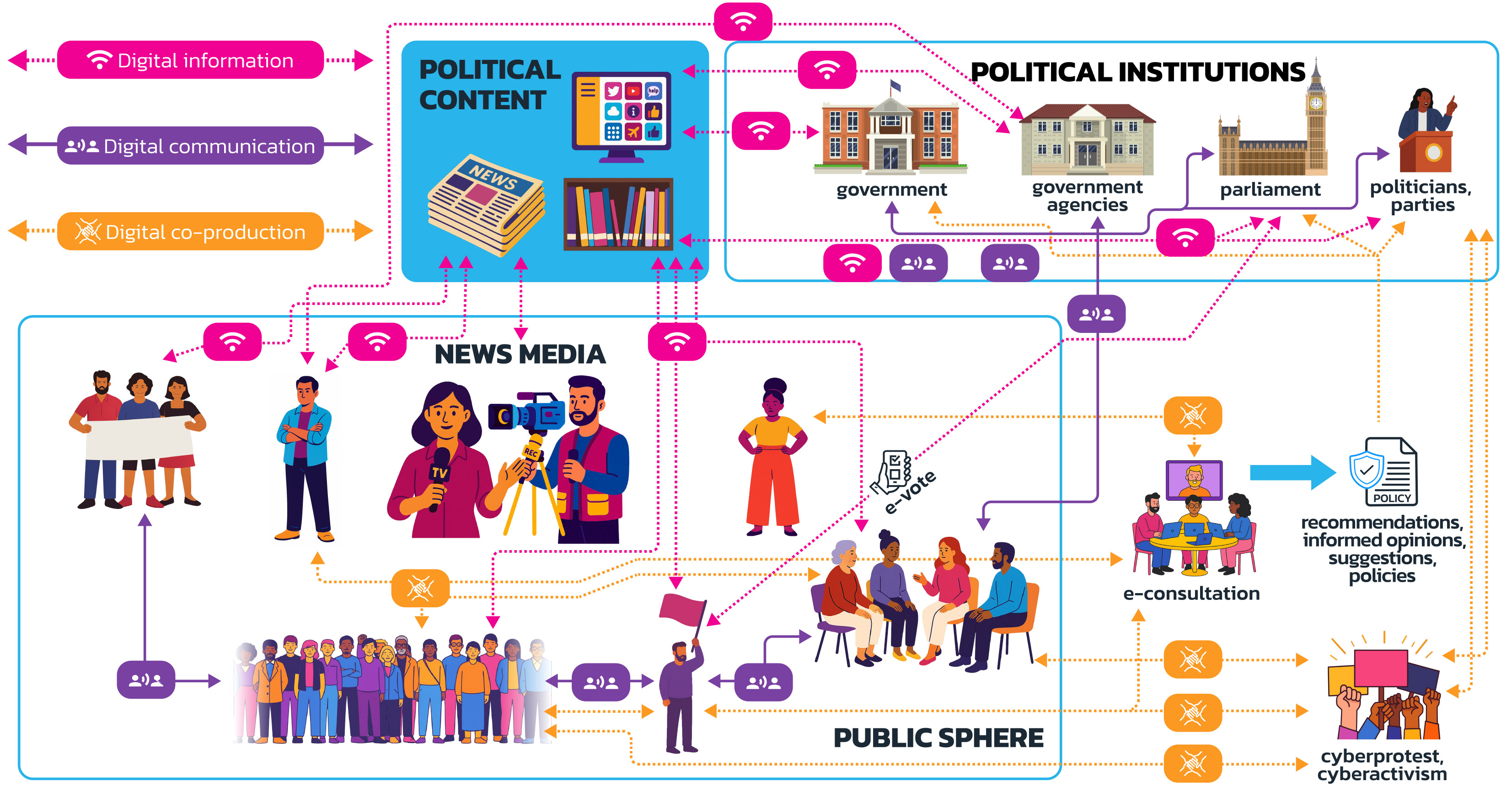
A new journal article by Christian Fuchs in the Journal of Information Technology & Politics discusses the question: What is digital democracy?
The paper is a research result of the Horizon Europe-project INNOVADE: Innovative Democracy through Digitalisation
Christian Fuchs. 2026. What is Digital Democracy? Journal of Information Technology & Politics, Online First, DOI: https://doi.org/10.1080/19331681.2026.2660162
Abstract
This paper asks: What is digital democracy? It outlines some foundations of a theory of digital democracy and introduces a novel approach. A review of influential understandings of digital democracy shows the dominance of the two models of deliberative and participatory democracy. In the contemporary poly-crisis of world society, there is an antagonism between digital communicative participation and digital fascism. Participation and deliberation can result in participatory fascism and deliberative fascism. As a consequence, we need an understanding of digital democracy that goes beyond the pure stress on participatory and deliberative digital democracy and foregrounds the potential combination of constitutional democracy on the one side and deliberative and participatory democracy on the other side. This paper suggests a novel approach to conceptualizing digital democracy that is multi-perspectival, multidimensional, non-dualistic, and based on a dialectic of technology and society. It suggests a typology of digital democracy that consists of four dimensions and six related and interacting models of democracy: constitutionalist digital democracy, representative digital democracy, direct digital democracy, pluralist digital democracy, deliberative digital democracy, and participatory digital democracy.
Christian Fuchs. 2026. Reason and Communication: Jürgen Habermas’s Legacy for Media and Communication Studies. tripleC: Communication, Capitalism & Critique 24 (1): 54-72. https://doi.org/10.31269/7112an90

What is Jürgen Habermas’s legacy for media and communication studies? Jürgen Habermas (1929-2026), a towering figure in critical theory, profoundly shaped media and communication studies by emphasising communication as the cornerstone of social existence. His theory of communicative action, rooted in the interplay between language, culture, and society, redefined communication as both a means of social reproduction and a site of democratic potential. Habermas’s concept of the public sphere – where communicative rationality confronts instrumental reason – remains essential for analysing how power structures, from capitalism to digital authoritarianism, distort democratic discourse. His critique of the colonisation of the lifeworld by systemic forces such as money and power offers a framework for assessing contemporary challenges, including algorithmic control, fragmented digital publics, and the rise of far-right ideologies online. By linking communication to emancipatory ideals, Habermas challenged scholars to interrogate the tensions between economic imperatives and democratic promises. His anti-fascist stance, informed by post-war Germany’s reckoning with Nazism, underscores the urgency of defending universalism and humanism against resurgent authoritarianism. While his dualisms (e.g., lifeworld vs system) invite debate, Habermas’s legacy lies in his insistence that communication is not merely instrumental but inherently normative – a space for contesting domination and imagining alternatives. This article explores how Habermas’s ideas on communication, the public sphere, and (anti-)fascism provide critical tools to navigate today’s mediated landscapes, where digital capitalism and ideological polarisation threaten the very foundations of democratic dialogue. Engaging with Habermas means confronting his blind spots while building on his vision of communication as a recursive process of social transformation. His work compels us to ask: How can we reclaim the public sphere in an era of algorithmic fragmentation and ideological extremism? Habermas’s answers, though provisional, remain indispensable for theorising communication’s role in fostering – or undermining – justice and solidarity.
Christian Fuchs. 2025. The Question of Methodology in Critical Political Economy of Communication and the Media. Journal of Communication Inquiry, Online First, https://doi.org/10.1177/01968599251405272
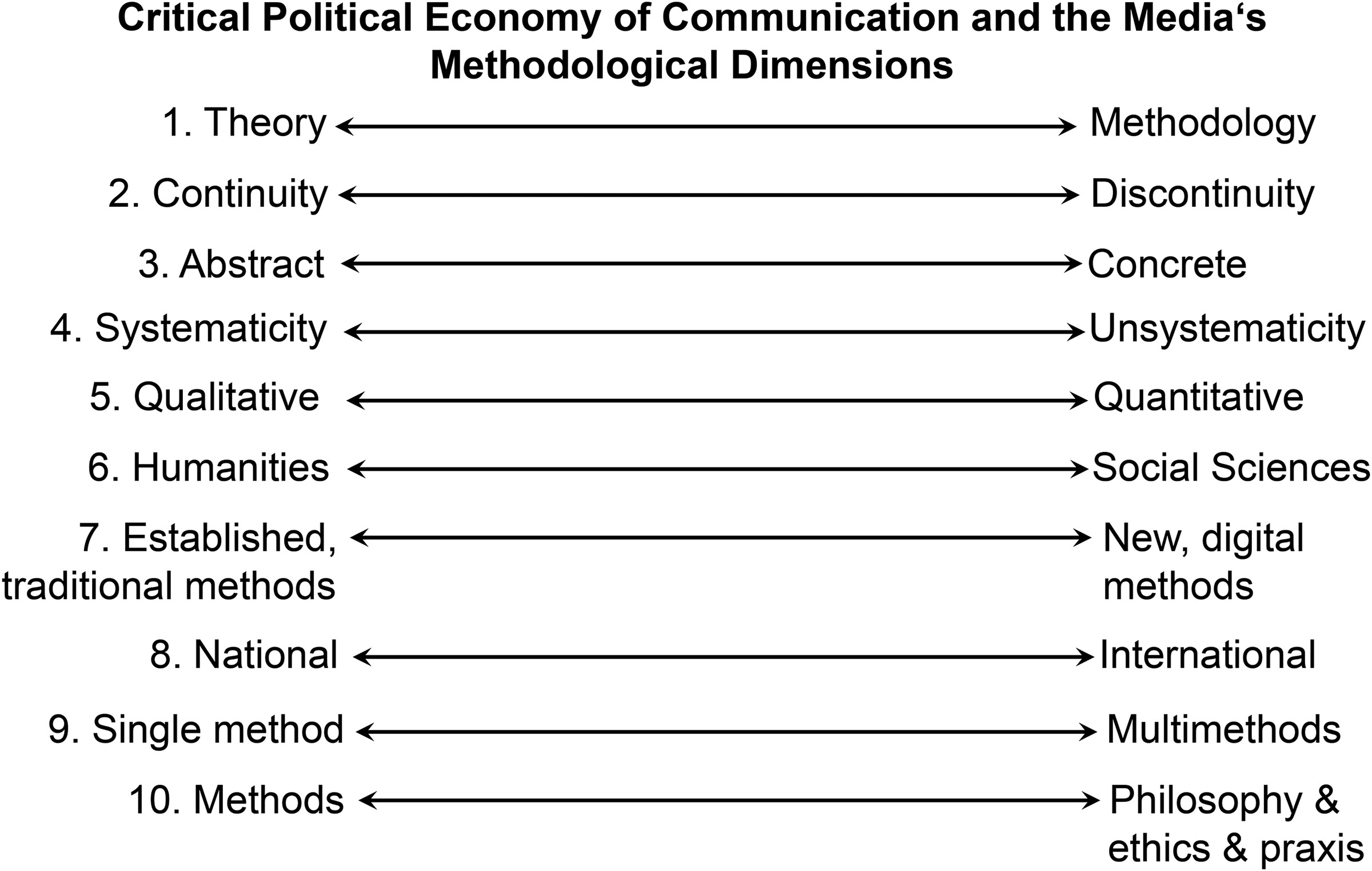
Critical political economy of communication and the media (CPECM) is an approach and field of study that critically analyzes how the interaction of politics and the economy in society shapes and is shaped by (mediated) communication. This study asks: What is the role of methodology in the approach of CPECM? How are methods and media ethics related in the critical study of media, economy, and society? The article argues that CPECM is distinct in that it asks special types of questions that are different from the questions asked by administrative research. This study points out 10 methodological dimensions of CPECM. It argues that empirical ideology critique should not be situated outside but inside of CPECM. It becomes evident that, other than conventional methods in media and communication studies, CPECM methodology is guided by ethics, moral philosophy, and critical theories.
Christian Fuchs. 2025. World War and World Peace in the Age of Digital Capitalism. London: University of Westminster Press. ISBN 978-1-915445-77-3 (pbk), 978-1-915445-78-0 (pdf), 978-1-915445-79-7 (epub), 978-1-915445-80-3 (mobi). 360 pages. DOI: https://doi.org/10.16997/mpub.13082283
“This is an excellent, wide-ranging account of thinking about war in the context of new forms of capitalism, providing original analysis of the global dimensions of contemporary war while reflecting on the heritage of sociological theory. It will lead to a rethinking of priorities in social theory.”
— Sylvia Walby, Professor, Department of Law and Criminology, School of Law and Social Sciences, Royal Holloway, University of London
For more information, click here
The fourth edition of Christian Fuchs’ textbook “Social Media: A Critical Introduction” was published in December 2024. It is available in an English and a German edition. The book gives an introduction to the use of critical theory for the analysis of the Internet and social media in society. The book has been adopted in hundreds of university courses across the world.
More information on the English edition
More information on the German edition
Thomas Allmer, Sevda Can Arslan, and Christian Fuchs, eds. 2024. Critical Perspectives on Digital Capitalism: Theories and Praxis. Communication, Capitalism & Critique 22 (1): 140-433.
 Full issue: DOI: https://doi.org/10.31269/triplec.v22i1.1501
Table of Contents https://www.triple-c.at/index.php/tripleC/issue/view/49
tripleC’s special issue on “Critical Perspectives on Digital Capitalism: Theories and Praxis” presents 14 papers and an introduction that contribute to establishing foundations of critical theories and the philosophy of praxis in the light of digital capitalism. In Marxist theory, a theoretical and analytical strand has emerged that is focused on the roles that knowledge, communication, media, digital media, and digital communication play in and beyond capitalism. This special issue is a contribution to this type of Marxian analysis and theory construction.
More info and link to all articles can be found here.
Christian Fuchs has published a textbook on the foundations of media, economy, and society. It is available in English and German.
 |  |
Christian Fuchs. 2024. Media, Economy and Society: A Critical Introduction. Abingdon: Routledge.
Christian Fuchs. 2023. Grundlagen der Medienökonomie: Medien, Wirtschaft und Gesellschaft. München: UVK/utb
The book introduces a variety of methods and topics, including the political economy of communication in capitalism, media concentration, advertising, global media and transnational media corporations, class relations and working conditions in the capitalist media and communication industry, the Internet and digital media, the information society and digital capitalism, the public sphere, Public Service Media, the Public Service Internet and the political economy of media management. Each chapter features a highly accessible introduction, recommended readings and lots of practical exercises where you will apply the Political Economy approach to concrete examples and cases.
More information: English book version, German book version
Christian Fuchs. 2023. A Marxist-Humanist Perspective on Stuart Hall’s Communication Theory. Theory and Society. Online First, DOI:
https://doi.org/10.1007/s11186-023-09524-5 
At the end of his life, Stuart Hall called for the reengagement of Cultural Studies and Marxism. This paper contributes to this task. It analyses Stuart Hall’s works on communication and the media.
The goal of the paper is to read Stuart Hall in a manner that can inform the renewal of Marxist Humanism and the development of a Marxist-Humanist theory of communication. This involves reconstructing elements of Hall’s approach, criticising certain aspects of his work, and through this engagement developing new theory elements.
The article’s analysis of Stuart Hall’s theory of communication and the media is conducted in four steps. First, the paper reengages and re-evaluates what Hall called the two paradigms of Cultural Studies: Structuralism and “Culturalism”/Humanism. It discusses the role of human agency in society. Second, the paper engages with Hall’s and Althusser’s notions of articulation and sets the notion of articulation in relation to the concept of communication. Third, it discusses the relationship between communication and work in the context of Hall’s works. Fourth, the article revisits and engages with Hall’s encoding/decoding-model in the context of digitalisation.
This paper grounds a dialectical concept of communication that is based on the dialectic of articulating and articulatedness, the dialectic of work and communication, as well as the dialectic of communication in the public sphere and society’s power forcefields. It shows how a critical, dialectical theory of communication benefits from engagement with Stuart Hall’s works. The present work argues with, for, against, and beyond Stuart Hall in order or productively draw on ideas that emerge from this engagement.
Christian Fuchs. 2023. The Problems of Base/Superstructure and Ideology in the Works of Stuart Hall, Georg Lukács, and Raymond Williams. The Communication Review. Online First, DOI: https://doi.org/10.1080/10714421.2023.2242068 
We live in times of deep crisis. General crises of society often are accompanied by ideological struggles. Given this context, it is important that social theory reinvigorates the analysis of ideology. For doing so, it makes sense to engage with classical theories of ideology. This paper contributes to this task. It asks: How are the economic and the non-economic related? What is ideology? This article deals with the base/superstructure problem and the problem of ideology via an engagement with selected aspects of Stuart Hall’s, Georg Lukács’s and Raymond Williams’s works. The commonality of Hall’s, Lukács’s and Williams’s thoughts that makes a joint engagement with their works feasible is that they all three dealt with aspects of culture from a critical theory perspective and are in one way or another representatives of Cultural Marxism. While Lukács’s works and Cultural Studies are often presented as conflicting approaches, this paper shows that concerning the question of how the economic and the non-economic are related and how we can think of ideology, the approaches of Lukács, Williams, and Hall complement each other, which allows critical theories of culture to draw on all three approaches and to combine elements from them in a synergistic manner. There are parallels between Williams’, Hall’s, and Lukács’s solutions to the base/superstructure problem. Williams argues that the economic exerts pressures on and sets limits to the non-economic. Hall writes that the economic determines the non-economic in the first instance. Lukács argues that the economic circumscribes subjectivity and the non-economic